Meaningful Living in the Hashtag Age

Archive for the ‘Uncategorized’ Category

The Three Things I Learned About Love That Changed My Life
Love is the most powerful four-letter word ever spoken. It is mentioned over 500 times in the Bible, featured in songs on more than 100 million records, and regarded as a fundamental human need that supports everything from our mental and physical health to spirituality and personal development.

To the scientific theorist, love is an emotion that triggers the release of feel-good hormones, such as dopamine, which is central to the brain’s reward system and helps deactivate the processing of negative thoughts and actions. It can help reduce stress, fight depression, and enrich our quality of life through physical and mental growth.

To the romantic or idealist theorist, love is the foundation of our relationality, our bonds, and our spiritual capacity to connect with others. It engages the heart and emotions, cultivates empathy, and makes life more meaningful.

The debate over whether love is a complex process of the brain or an intimate emotion of the heart continues to grow. But to me, the answer is somewhere in between. In the gray areas of this debate, there lies a brilliant light, a beacon of understanding that those like me, who are seeking purpose, have embraced throughout life’s journey. Therefore, I wanted to share three lessons life has taught me. This is not just for the romantics, but for the parents who wonder whether their children understand the depth of their love, for the wife who forgives when others advise her not to, and for the ex-lover who lost the love of their life and now must start over. Below are the three things I learned about love that changed my life for the better:

#1 You can love someone who doesn’t love you back.

This one is hard for most people to accept. If love is an emotion that drives connection and creates feelings of joy and happiness, then it must be shared between two people who feel the same way, right? What if I tell you that you can love those who don’t reciprocate the love to you and that by mastering this selfless act, you will experience the emotional highs and physical and mental advantages of true love. I learned during a difficult breakup that the best way to get over someone who chooses to walk away isn’t to work tirelessly to erase your love for them. Instead, it’s to love them fully—to express that love through both words and actions—and to allow that love to give them the freedom to seek what’s best for them, even if that no longer includes you.

To do this, one must remember what God teaches us about love. The Bible says: “God demonstrated His love by sending Jesus to die for sinners” (Romans 5:8; John 3:16). God showed His love by sending His only Son to die for those who would not obey Him — people who refused to love Him or heed His words. God puts love first because love heals all wounds — this is the most powerful act of kindness this world has ever known.

Brokenheartedness does not give us the right to stop loving those who hurt us; instead, it prompts us to activate what Galatians 5:22–23 calls the Fruit of the Spirit, which lists these qualities: love, joy, peace, patience (or forbearance), kindness, goodness, faithfulness, gentleness, and self-control. By activating this form of love, we can find peace within ourselves and offer compassion to others even when they don’t love us back.

Too many people use love to justify hate. We say things like, I loved him, and he didn’t love me back, so now I need to stop loving him and force my mind to forget all that we shared. But what if true love is about doing the complete opposite? What if letting him go means learning to love him as God loves us — unconditionally? So instead of feeling that someone you love deserves less of your love, you love them more — triggering that dopamine to help you feel good about yourself and your decision. Then you allow your emotions to feel the beauty of the love you shared, and let love lead you through the process of letting go.

What I’ve learned over the years is that forgiveness, acceptance, and respect for someone’s decision to stop showing me emotional love were my way of allowing myself to love them even when it hurts. As a result, I found a deeper, more meaningful love for myself. I learned to stop allowing emotional love to drain the very thing that had given me internal peace.

#2 Love is a victimless act.

Everyone wins when true love prevails. This is the kind of love God shows us. When He tells us to love our neighbor as ourselves (Matthew 22:39), to do everything in love (1 Corinthians 16:14), and to define Himself as the embodiment of love (1 John 4:8), He confirms that where love exists, pain can be bearable; where love exists, darkness cannot survive; and where love exists, evil is made powerless. When love is the foundation of your relationship with yourself or with others, it takes no prisoners. It teaches you to stop focusing on what hurts you and start reveling in all the sweetness and joy that life can bring.

So, if the one you love chooses to stop loving you, don’t become a victim of the pain; instead, let the journey empower you. Then work toward healing before seeking an even greater love. Let it be a light onto a better path rather than a dark, lonely journey into despair.

You may wonder how love can make you a victim. But the answer lies in the countless people who spend their lives remembering the pain of a past hurt. Someone took their love away, and the person left behind struggles to move forward, justifying every failure to move on as a result of the love they lost. I believe God doesn’t operate that way. He provides us with so many people — family, friends, co-workers, neighbors, and church members — who will love us whole. They will take up the banter and run the race of life with us. He doesn’t allow love to be weaponized; instead, it maintains its purity and goodness, allowing us to have the purpose-driven experiences He promised.

#3 Love does love you back.

Have you ever looked in the mirror and wondered what it is about you that makes you lovable? Have you traced the shape of your eyes and marveled at the steps you’ve taken to ensure a positive vision for your life? Have you stared at the authenticity of your smile and celebrated the many things you’ve done to find the happiness you deserved? You are a masterpiece, and no one knows that better than God. How does He show you that He knows how great you are? Through love. When peace looks back at you from the mirror, it’s a sign that you’ve learned to love, admire, and accept yourself. That’s how I know love loves you back. When you express it genuinely to others, you are rewarded tenfold. When you allow love to conquer evil, your life benefits from the peace you receive, and when you let yourself be loved, you accomplish the greatest joy life has to offer.

What I’ve learned about love during my life journey sustains me. When people aren’t kind to me, I love them anyway. When my relationship doesn’t last, I let love heal me and then lead me forward. When life feels void of the love I desperately need, I turn to God and let His love anchor me.

THE DOOR: A TRIBUTE TO MY FATHER, MATTHEW SMITH, SR.

A BLACK WRITERS WORKSPACE POETRY COLLABORATIVE

Prelude by Michelle D. Jackson

Located in New Birth Missionary Baptist Church (Birmingham, AL)

On Friday, January 28, 2022, my father died.

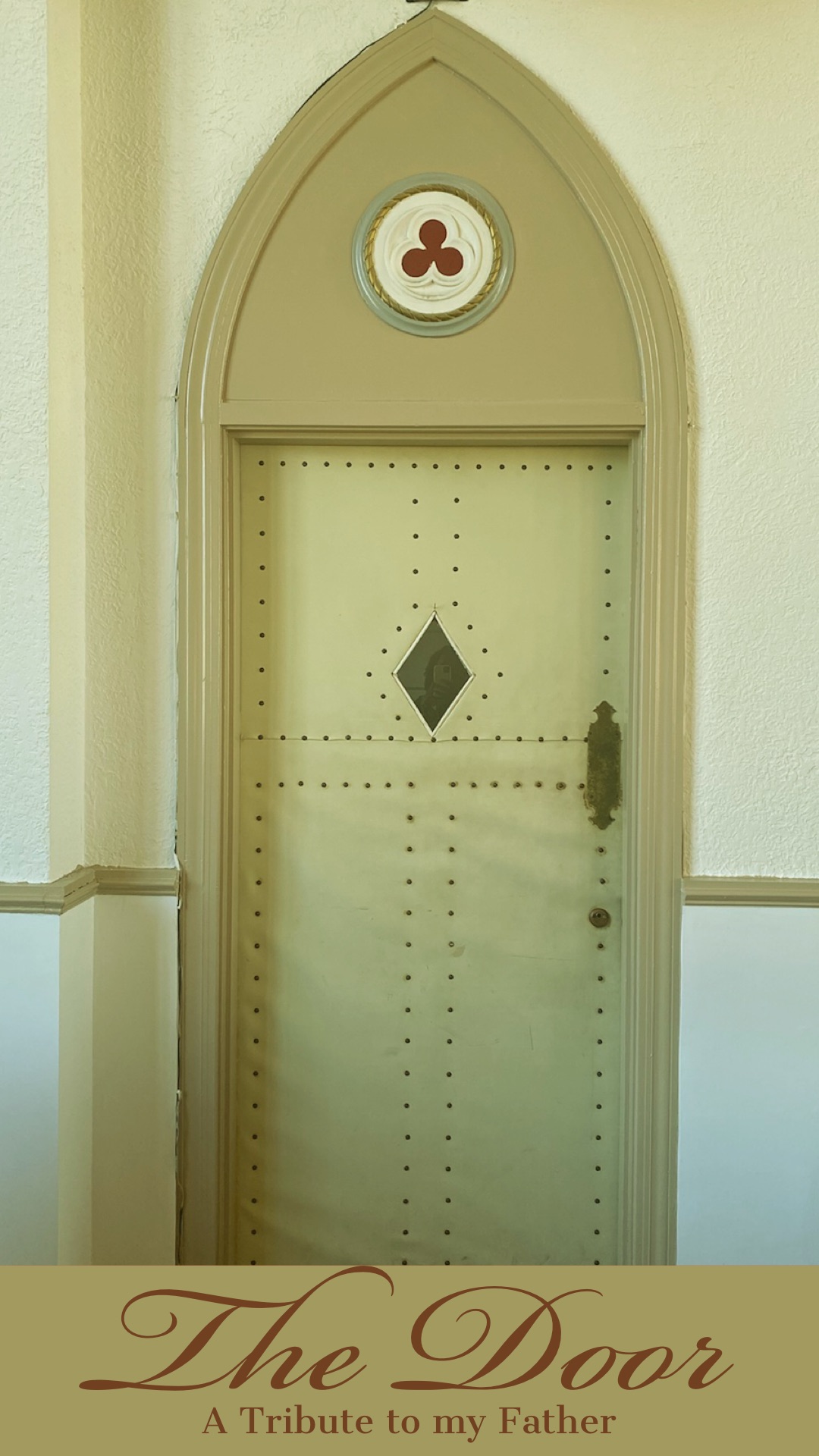
During his funeral, as I sat staring at his regal bronze casket covered with an American flag, I noticed a beautiful metal door in the church with a three-circle emblem representing the Holy Trinity. Mesmerized by its design, I began to wonder about the door of eternal life my father had now entered. This door represented the pathway from earth to heaven.

Somewhere in the heavenly clouds was my father, a man in his late eighties who survived poverty as a young boy and blatant racism in the south—a complicated man whose love shined through even in the harshest times. I did not always understand him, but I knew and loved his strength, courage, and unspoken belief in forgiveness.

The door that stood before me represented his path to a final resting place, a course we will all one day endure. It was this door that had the last word on his life. Yet, poetic in how its silence spoke to the numbness of my heart, I knew that once he walked through it, my father would receive his heavenly reward for a life well-lived. 

With the help of my friends on the Black Writers Workspace, we crafted separate parts of a story, my story, our story of grief, loss, and the journey from this world to eternal life. Through the beautiful and heartfelt poetic words of writers everywhere, they helped me share my pain, and I am forever grateful. Here’s our collaborative work:

THE DOOR

by The Black Writers Workspace

I.

Entering another day without you

Broken but strong

Your laughter a beautiful memory

Lasting a lifetime long

Remembering how you loved me

Rarely spoken but always felt

Remembering your dreams for me

Tackling the world as it’s dealt

My first Valentine

The man who loved me most

The warrior in my mind

when this life’s beyond reproach

The meals we shared

The smiles we gave

The slightest touch of your hand

Your love pierced my little girl heart

Your love is where I stand

You are, and will always be,

the fire in my belly

The fight in my step

The man who made me, me

The guy who accepted his missteps

A daddy indeed

A rebel

A soldier

A fearless heart

A powerhouse

A complicated soul

The door will never keep you

For your life is still ashore

But the door will let you rest

Share your greatness on high

Remind your earthly family of you

Propel us toward the sky

Sleep, daddy, sleep.

You deserve to rest

You’ll never be forgotten

Your soul is at its best

Michelle Jackson

II.

Entering another day without you,

Consumed with all I’ve lost.

You’ve always taught me to win,

Eventually, I will, but at what cost.

Nothing can prepare us for the sea,

After we pass the door of no return.

Without your covering, who will we be,

Who knows, yet we must learn.

A day at a time is what they say,

When I don’t know what day it is.

With doors closing all around me,

I feel as helpless as a lost little kid.

Even when that door slammed shut,

Inside of me, I still felt your light.

I’ll try to breathe deep to find small bits of peace,

remembering you, day by day & night by night.

Barnard Sims

III.

On solid foundation

framed in love

hung in place delicately hinged

like the wings of a dove

You’ve Always been wide open to me

But today you are sealed tight

And nothing seems right

As I stand here on the threshold of your memory

Thoughts race

My heart flutters to keep pace

Anticipating the turn of the knob

Unopened yet somehow

“un-closed”

In the middle of the end

My silent tears give away to sobs

Lawanda Baker


IV.

Thro’ it we into life are usher’d

Squalling and kicking lustily

Bringing joy to the hitherto bother’d

And thro’ the door out of life

We exit

Lying still and pale and rigidly

After our course of life is run

Leaving sadness and pain behind as we go

Never to return

David Donald

V.

This is the door of forevermore.

On the other side I’m expected to say good-bye to the first man who loved me.

I’m grateful he got to guide me through this crazy awesome journey.

When I leave the room and that door closes, I will not be the same.

I am not prepared for the heartache, the grief and pain.

So please remind me to think of the good and push away the bad.

Remind me of the times when I wasn’t so sad.

Show me a penny, a red robin or rainbow.

Remind me your energy will always flow.

This way I don’t have to say goodbye, instead I’m reminded

You are by my side.

Now, I can close the door to forevermore.

Gina Johnson

VI.

Some people look at a closed door as an end.

But the door doesn’t just close. It opens too.

On this side of the doorway, I saw you Daddy and knew

I would never see you in the form I was used to.

Laughing, telling jokes and being the life of the party.

But as you stood at the doorway, you knew once you crossed over,

you would have to make your presence known in other ways.

So now, I hear you in my sister’s laughter, I see you in my brother’s face

and I feel you every time I go home to visit family.

The doorway isn’t just the end, it’s a different beginning.

Angela Jackson Muhammad

VII.

Open. Open. Open. Please door just open
Let me have one last hug or one last glance
Just one small moment
Just one final chance.

I wasn’t ready for you not to be here
Even though I knew it was now your time
My mind says it’s going to be OK
But every part of me knows it’s lying

This door is the only thing between us now
Separating two hearts that should always be together
But as detached as I may feel right now
I know your love and memories shall last forever

I know this door is forever closed
No matter how much I cry
Life will be forever different without you
But with each day, I know I’ll get by

I will live life grateful for the time we did have
Never to forget your life, laughter, or love
Wait for me on the other side of that door
So when it opens, all I hear is, “Welcome”

Tamecka Knight

4 Things I Learned This Week From 4 Black Authors

Every day brings a new opportunity to learn, love, and grow. Failing to take advantage of these opportunities will result in regrets. Therefore, I opt never to have regrets, but instead to be a student of life.

This week my life lessons came from four black writers who I respect — blessed with the opportunity of a lifetime to interview three of them during the BLK. INK virtual book fair hosted by the Black Writers Workspace, I learned several key life lessons from Kevin Powell, Ardain Isma, and Odessa Rose. Also, as I honored the life and legacy of the late author and activist bell hooks, I immersed myself in her words and took another life lesson with me that I want to share.

Lesson #1 — Books have POWER.

During my interview with Kevin Powell, author of 14 books, journalist, activist, and filmmaker, we engaged in an honest conversation about his autobiography “The Education of Kevin Powell: A Boy’s Journey into Manhood.”

Kevin’s book is his life story of surviving poverty and crime in the streets of New Jersey. It explores how he found his way into a world of activism and community building. It also covers the exciting role he played in the launch of hip hop music and his journey to becoming the man he, his mother, and those he loved would respect. The book is honest and raw, and I connected with his story in ways that surprised me.

Although we grew up in different parts of the country, Kevin and I are products of poor/working-class communities, hard-working and no-bullshit mothers, and a soul-stirring love of books and hip-hop music.

But with all our similarities, I left the interview learning the most simplistic lesson. Kevin reminded me that books have the power to change lives.

Books changed the trajectory of both of our lives by transforming our impoverished minds, bodies, and spirits. Books changed how we saw ourselves and our surroundings. They allowed us to dream and to expand our worldviews. They opened doors and connected us to braver possibilities.

For Kevin, books like “The Autobiography of Malcolm X” ushered in his love of activism. Because of his experiences, his writings and literary accomplishments secure his place in history as a modern-day griot, telling life stories during the rise of hip-hop and in the trenches of police brutality, racism, and sexism post-civil rights movement.

My time with him was short but meaningful. I am a better person because of our encounter, and now I’m convinced, more than ever, that black writers must keep writing.

Lesson #2 — The Black Experience IS the Human Experience.

My interview with writer, college professor, and Haitian historian Ardain Isma revigorated my interest in embracing the black experience from the African diaspora to now.

As we discussed Ardain’s journey from Haiti to America at the age of 17, he reveals the heartbreak he felt leaving his mother behind and his renewed focus on education and writing in his new homeland. As a result of his love of writing, Ardain penned two books seeded in his love of Haiti and his commitment to Black empowerment. He also hosts a YouTube interview series where authors have a platform to talk about their work, and he’s the Editor-In-Chief of CSMS magazine.

Ardain introduced me to ‘The Equality of the Human Races’ by Author Anténor Firmin, a pioneering work of early anthropology written in French by a Haitian who is one of anthropology’s first scholars of African descent. Firmin published the book in Paris in 1885, twenty years after the ‘Father of Racism,’ Count Arthur de Gobineau, published “The Inequality of Human Races.” De Gobineau’s racist tome was translated into several languages and influenced Nazi ideology. But, decades ahead of his time, Firmin’s work proved that the human races are equal.

I felt a sense of pride learning from Ardain, his love of Haiti, and his commitment to sharing the prolific life story of great minds like Firmin. Racism was purposely embedded into the foundation of nation-building. Books like De Gobineau’s helped infuse systemic discrimination and inequality in every facet of life. I left this conversation understanding that our country will never embrace unity and equality until we appreciate the black experience.

Lesson #3 — Write what you LOVE!

My final interview led me to embrace the work of a black, heterosexual, female writer who took a chance to write a fictional story about a black, gay, female character in a contemporary novel that became a featured movie.

Until our interview, I’d never met Odessa Rose, the author of “Water in a Broken Glass,” but I’d followed her work on social media. Nothing prepared me for her humble demeanor, love of words, and Baltimorean pride.

Odessa wrote “Water in a Broken Glass,” a novel about a sculptor who struggles with her sexuality and self-image. The storyline was conceived after Odessa’s chance encounter with a friend who was concerned about coming out to her for fear of how she would respond. Hopeful to help others in similar situations, Odessa’s story is a good lesson for people who are either dealing with coming out to friends and family or are having a hard time accepting the sexuality of someone they love.

Like so many writers, Odessa told the story that kept her up at night. She listened as the character developed within her spirit, and she let the story drive her to write a book that was so convincing that a filmmaker asked, and ultimately earned, the rights to turn it into a movie.

Our discussion clarified that if I’m going to be a writer, I must write! Sometimes the work will let me know it’s ready to be delivered to the world. Sometimes readers will beckon for my stories, and I must trust that the world is prepared for my greatness. Nevertheless, great writers WRITE! Odessa’s story proved this to me.

Check out “Water in a Broken Glass” on Amazon Prime or Apple TV.

Lesson #4 — Love is EVERYTHING!

This week we lost another great author, activist, and leader. bell hooks parted this life, but she did not part our hearts. Instead, she gave us the most exceptional understanding of love, forgiveness, and unity. Her life story embodies the lessons I hope to live forever. I embrace her greatness and pray it will sustain me for years to come:

The moment we choose to love we begin to move against domination, against oppression. The moment we choose to love we begin to move towards freedom, to act in ways that liberate ourselves and others.
— bell hooks, Outlaw Culture: Resisting Representations, 1994

To Kevin, Ardain, Odessa and bell hooks, thank you!

HERO IN YOU

Are you in need of a HERO? Are you waiting on a SUPERMAN or WONDER WOMAN to descend from the sky and protect you from a struggling world?

What if there are no heroes coming to your rescue? What if you have the STRENGTH and courage you need to change the world, and YOU were created to be the HERO of your own life?

Each one of us is blessed with the talent to build a world comprised of integrity and goodwill. But to do so, we must ACTIVATE our faith and move into our destiny.

In these unpredictable times, it’s important that we stop waiting for our heroes to rescue us and start LIVING like the responsibility is ours, and ours alone.

So, ask yourself: Am I up for the task? Am I warrior-ready? Can I be a hero in my community? Can I be a hero in my home? What will it take to change the world around me for the better?

If you possess the power to be a strong leader, change maker, founder, AUTHOR or advocate, start TODAY! Put on your cape, strap on your armor and get ready to sacrifice your life for what is good and honorable.

Be your own HERO and watch your life soar!

~ Author MJ
Blog: http://www.1stmorningthoughts.com

What Google fails to understand about the beauty of brown skin

When Michelle Britto, a black writer from New York, went online to search for examples of a brown-skinned model to show the tone and texture of African American skin complexions to her children’s book illustrator, she discovered something that caught her attention.

Just as she struck the Google image search icon, a skin color index with illustrations of varying skin tones appeared on her computer screen. It did not take long for Britto to realize that the easily found Google image was more than a chance discovery; it was the encouragement she needed to address the negative stereotypes and systemic colorism that has hindered women of color for centuries.

The skin color index, which showed one image of a woman in six different skin tones ranging from light (or Caucasian) to dark (or African/black), described the lighter skin tone as “normal.”

This presumption is not uncommon to black women who have existed in a society that subliminally implies that a woman’s beauty and desirability is based on the color of her skin, the hue of her eyes and the length and texture of her hair. Societal norms are filled with images of white women as examples of true beauty and black women, particularly those with darker skin, are seen as exemplars of the aesthetically unattractive.

Historically, black women were represented as maids or ‘mammies’ — black maid-servants — during slavery who looked and acted in ways to satisfy their male-masters while deemphasizing their beauty to appease white female slave masters and make them feel beautiful in their presence. Even as more women of color emerge as dominant figures in business, movies, music, and sports, there remains an unconscionable belief that women of color are less appealing in comparison to women with lighter skin.

Britto, with a new-found urgency to correct the unfair and stereotypical skin color index and redefine what “normal” means, decided to enlist a few of her writing colleagues to help demystify the beauty all women of color embody. They call their work, The Skin I’m In: A black women writer’s protest to the negative images of dark skin and the cultural upliftment of all women of color. This work is a living document to be continued by women writers with strong voices and an unwavering belief that skin is beautiful no matter the color, tone, or texture.

The Skin I’m In by Women Writers of Color

Almond Toasted by Michelle R. Britto

Almond toasted brown is my skin tone by birth.

When I look in the mirror there is nothing that makes me irk.

In the summer is when my DNA is put through an undeniable test.

It’s when my skin is at its absolute best.

It turns copper once the sun sets in.

The skin I’m in reminds me that my Afro-Caribbean is not just a part of my past, but a part of my now.

The sun treasures my skin.

It’s so “NORMAL” the way it colors in.

No sunscreen of 101.

My skin embraces the light because we are one.

Shea butter nourishes my skin,

And I can feel a glow from within.

My skin is EVERYTHING to me.

It tells the story of plantations and cotton fields.

My light brown skin was considered a plus,

In a house full of sin my ancestors could not fuss.

Had I’d been there; I’d say leave me to the corn rows and cotton fields.

So much pride, no longer in those years.

Melanin is beauty, yet it’s what many fears.

Thomas Jefferson had his share of my skin tones.

The number of his kin is still unknown.

To call my skin not “NORMAL” is the biggest mockery of all.

Today I celebrate my skin as the diaspora of a history that doesn’t break me.

Imagine Google in 2020 trying to berate me.

The day I googled skin tones and a white image appeared, it was called “NORMAL,” I see no “NORMAL” here.

Caramel Brown by Michelle D. Jackson

My complexion is not what the world would call “NORMAL.” Normal is too safe for the life I was made for. It is a blank canvas with no brilliancy or light; it is a monochrome palette, with no creativity or imagination. Normal is a predictable stream of consciousness that lacks thrill and luster. No! I am not NORMAL — God did not make me that way. Instead, He broke the mold when He birthed me in the swell of an Alabama sun. Blessed me in the belly of a light skin queen and in the loins of a russet-skinned king, both only a few generations removed from the cotton fields.

God crafted a beauty only majesties could comprehend. He spared no grace, mercy, miracles, or mystery when he buried my warring soul in copper-tone mink and covered my body in buttery sweet caramel brown skin. I do not care to be “normal” or to fulfill an earthly man’s desire. My skin is a reminder of the strength that flows in my bloodline. It screams to the world what my brave ancestors whispered daily to the wind — I am something wonderful. I am something real. I am something desired. My power lies in the beautiful brown skin I’m in.

Espresso Almond Butter by Jacquelyn Randle

Complex yet beautiful none the less. A shade that changes throughout the seasons glowing whenever the sun hits it. An illuminating radiance, reminiscent of a mother’s pregnancy glow. A shade often overlooked in the debate of dark skin versus light skin in my youth; outside confusion saying, “you’re so bright” while others saying the classic “you’re getting dark.” Stuck in the middle of the color spectrum. Memories of being young and arguing that “I’M BROWN, NOT BLACK,” not realizing BLACK IS BEAUTIFUL NO MATTER THE SHADE. Stuck in the middle admiring the blue-black shades fresh from The Motherland or the rare red hair and freckles the lighter end sometimes gained from their DNA. Espresso almond butter is me. My children offshoots of its variance, soaking in the knowledge that our skin is not only unique but the curls on our heads that shrink then extend down pass our backs. Picking up the quick wit to answer “melanin,” when asked what are we mixed with or the knowledge to know that Crayola has yet to perfect our shade of Espresso Almond Butter but we can mix up a few and get it just right.

Espresso Brown Skin by Tam Yvonne

Silky smooth, so creamy, a shiny skin tone that overflows with warmth and luminosity effortlessly… dark in color, chocolate like a Hershey bar, who be that woman? That woman be ME! But, “ME” is not considered “NORMAL” in a world that tells you light is beautiful and publicly demonize anything dark in color. Even in my black community we have been brain washed, courtesy of the Willie Lynch Letter 1712, where this British slave owner taught his methods to other slave owners on how to control your black slaves. Several methods were shared, but the one that has always stood out in my mind, ever since I read that letter in my pre-teen years was the way he suggested using dark skin slaves vs. light skin slaves, and the light skin slaves vs. the dark skin slaves; and this method was evident back in 1712 with the dark slaves in the fields; and the light slaves in the house pampering babies and being play mates to the masters kids. Fast forward 2020; and I am still hearing from people in my own race, “you are beautiful for a dark skin woman.” Wow!! This is 2020, right? Why can’t I just be a beautiful woman? It still saddens me at times to see my own race of people; and the world in which we live not consider dark girls and dark women beautiful, dark skin has never been and still is not considered good enough. But, I am here to tell you, I have ALWAYS been PROUD and always will be of my skin complexion and how beautiful we are as a people in our various shades of brown that comes with a diverse and radiant nature that glows and is often times highly sought after from those with less melanin in their skin. GOD did a good thing when HE put me in the skin, I am in.

Dark Chocolate by Tendai Magidi

Fearfully and wonderfully made.

Unworthy of unprovoked attacks.

I hold an unquestioned right to be recognized as a respectable individual.

This black skin I`m in,

A distinguishing feature that facilitates my identification.

A part of me that never fades with age.

Resembles the uniqueness of my racial origins.

In this dark skin I am,

Which I wear proud and unshaken by racist taunts,

I bear a striking resemblance of true beauty.

In a storm of protest, I don’t wish to scramble for superiority but,

I raise a voice against the wrong and unfair resent of my black skin,

To solemnly express my concern for racial equality,

Tolerance and for all races to build unity

And maintain racial relations.

Colour difference does not make us different species.

Let not our difference in colour turn rejection into a norm.

Because of my black skin,

Turn me not into a victim of racial discrimination,

Shunned by society.

I`m not an epitome of misfortune.

My skin does not make me hideous.

Rather my black skin is my pride,

The reflection of my beauty.

I reflect no regrets of the colour I wear,

My black skin, My pride.

To connect with the writers, join the Black Writers Workspace Facebook Page

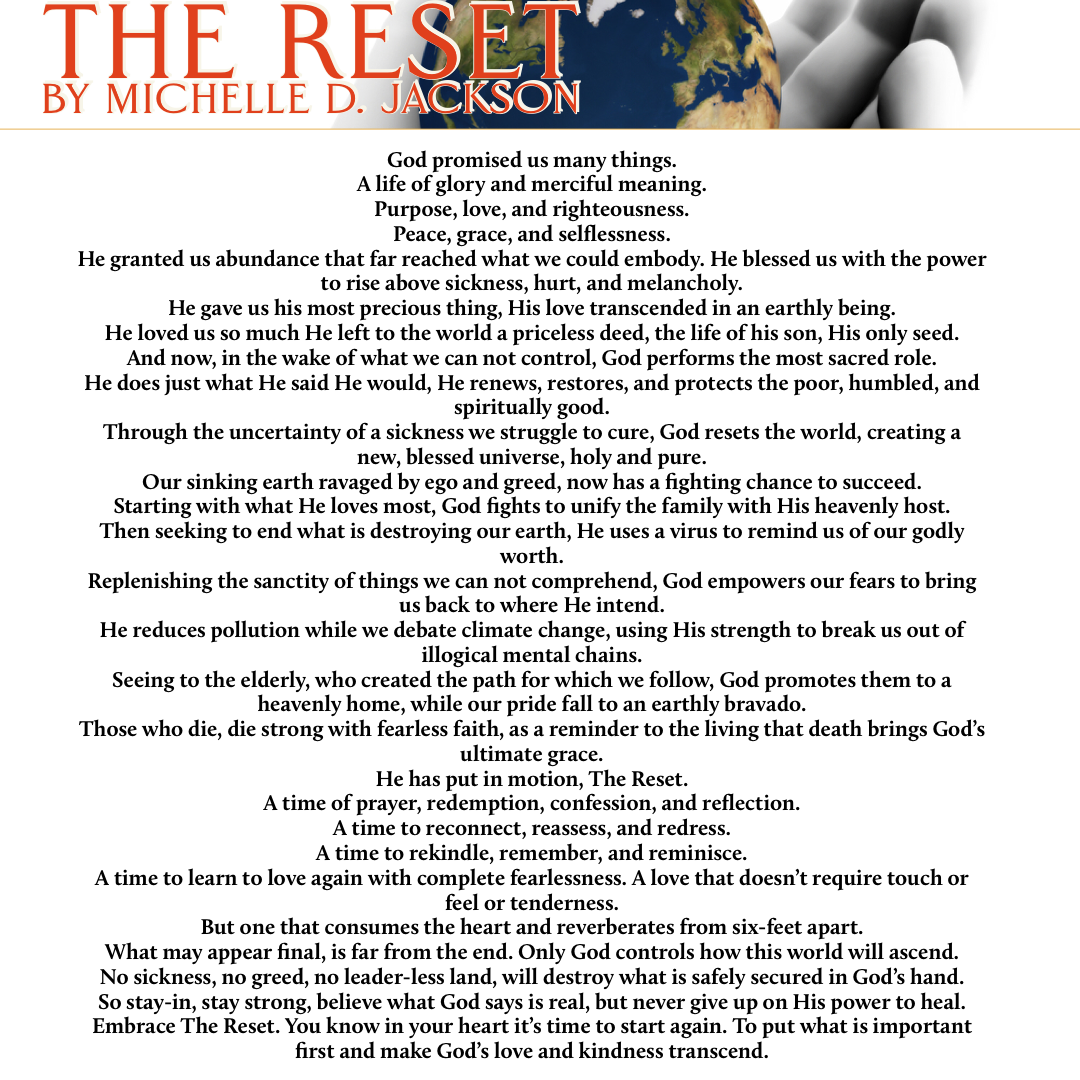
The Reset: A Poem of Restoration during the COVID Crisis by Michelle D. Jackson

God promised us many things.

A life of glory and merciful meaning.

Purpose, love, and righteousness.

Peace, grace, and selflessness.

He granted us abundance that far reached what we could embody. He blessed us with the power to rise above sickness, hurt, and melancholy.

He gave us his most precious thing, His love transcended in an earthly being.

He loved us so much He left to the world a priceless deed, the life of his son, His only seed.

And now, in the wake of what we can not control, God performs the most sacred role.

He does just what He said He would, He renews, restores, and protects the poor, humbled, and spiritually good.

Through the uncertainty of a sickness we struggle to cure, God resets the world, creating a new, blessed universe, holy and pure.

Our sinking earth ravaged by ego and greed, now has a fighting chance to succeed.

Starting with what He loves most, God fights to unify the family with His heavenly host.

Then seeking to end what is destroying our earth, He uses a virus to remind us of our godly worth.

Replenishing the sanctity of things we can not comprehend, God empowers our fears to bring us back to where He intend.

He reduces pollution while we debate climate change, using His strength to break us out of illogical mental chains.

Seeing to the elderly, who created the path for which we follow, God promotes them to a heavenly home, while our pride fall to an earthly bravado.

Those who die, die strong with fearless faith, as a reminder to the living that death brings God’s ultimate grace.

He has put in motion, The Reset.

A time of prayer, redemption, confession, and reflection.

A time to reconnect, reassess, and redress.

A time to rekindle, remember, and reminisce.

A time to learn to love again with complete fearlessness. A love that doesn’t require touch or feel or tenderness.

But one that consumes the heart and reverberates from six-feet apart.

What may appear final, is far from the end. Only God controls how this world will ascend.

No sickness, no greed, no leader-less land, will destroy what is safely secured in God’s hand.

So stay-in, stay strong, believe what God says is real, but never give up on His power to heal.

Embrace The Reset. You know in your heart it’s time to start again. To put what is important first and make God’s love and kindness transcend.

By Michelle D. Jackson

Well Done

A Message from an Overachiever with a Restless Heart for God

So often my friends and colleagues ask me, “Do you sleep?” This question is understandable because I can sometimes appear to be constantly working on a new project instead of enjoying my life. Therefore, I always pause before answering because I don’t know if the person is applauding my effort to accomplish my goals, questioning my ability to find peace and contentment in this life or if I look tired and weary from my work. Either way, the question ultimately leads me to think about Christ and his time on earth.

In only 33 years, Christ healed the sick and fed the poor. He counseled people in need and taught those who sought knowledge and understanding. He worked miracles that changed lives and fought for what was right. He loved people who didn’t love him back and he sacrificed his life for our sins. In 33 years on earth, Christ accomplished more than I or anyone could ever accomplish.

So, do I sleep? Yes. Comfortably. Because the things God has asked me to do with my time on earth is worth the sacrifice. It’s worth the long days writing, running my business and nonprofit, and taking care of my family. It’s worth the hard times when I’m unsure of myself but refusing to quit. Don’t misunderstand my work ethic or the work ethic of people in your life like me. I have an amazing life that I want to live like Christ. I’m just focused on one thing, and one thing only – hearing God say to me, “Well Done!” Then I will rest with him in peace for eternity.

Michelle Jackson is an entrepreneur and nonprofit leader and author of fictional novels The Heart of a Man and From Darkness to Night. To learn more about her work, visit http://www.authormichelledjackson.com.

What I learned from Hamilton The Musical

mjackson142014's avatar1st Morning Thoughts

To say I waited patiently to see Hamilton The Musical is an understatement. From the moment I realized it was the story of the American Revolution set to rap, I was sold. Despite the fact I couldn’t make my way to New York to see it on Broadway, and I wasn’t sure who the heck Alexander Hamilton was, I desperately wanted to see it the very second it hit the stage.

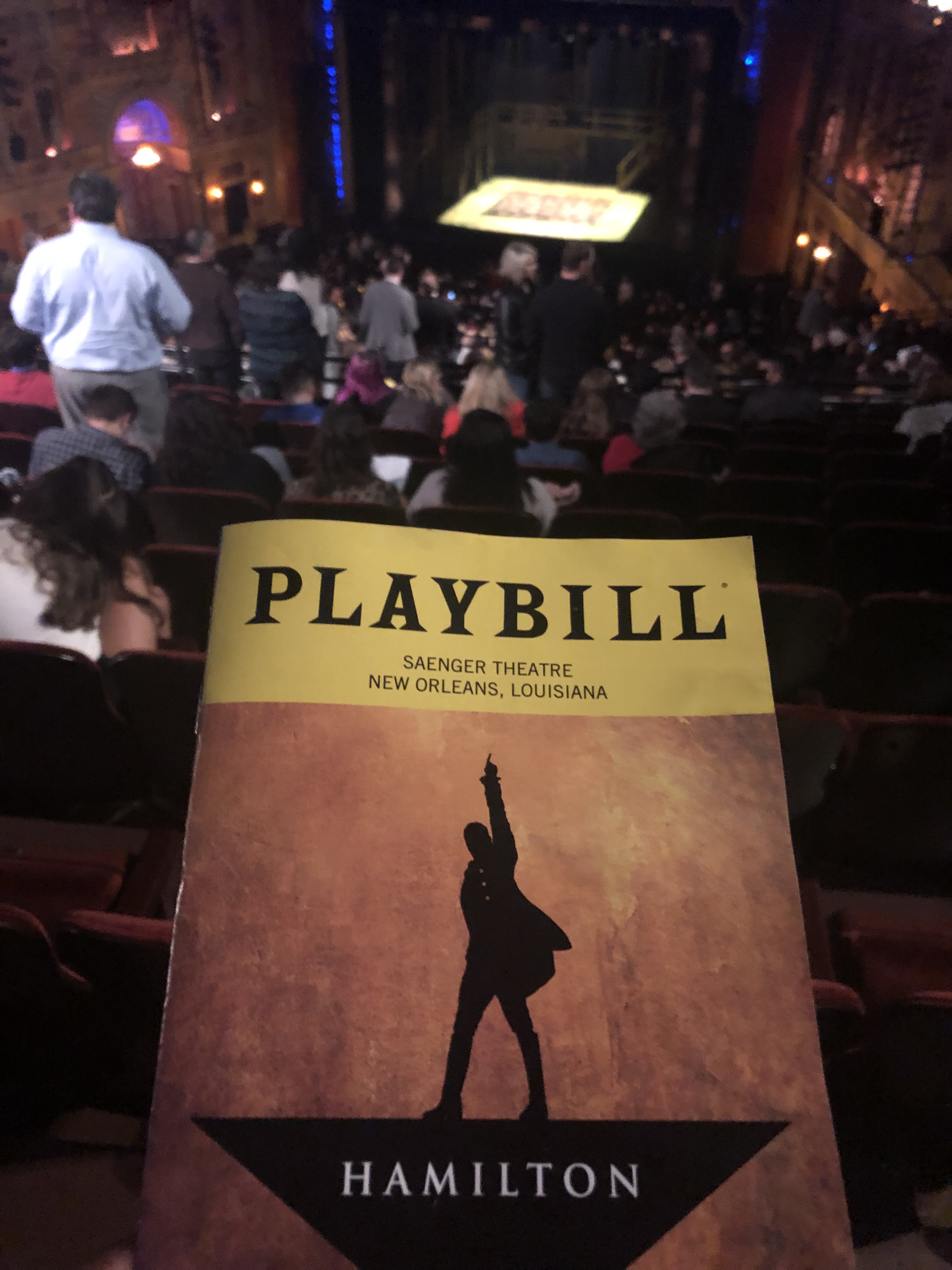
Fast forward a few years and the play is on tour and headed to New Orleans where I live. My husband surprised me with two tickets for Christmas and boy, was I excited.

An hour into the play and I realized how much Hamilton’s life was like my own. I too am in search of greatness or at least real goodness. I’m looking for ways to make a difference and leave a legacy. And most importantly, I’m trying…

View original post 670 more words

What I learned from Hamilton The Musical

To say I waited patiently to see Hamilton The Musical is an understatement. From the moment I realized it was the story of the American Revolution set to rap, I was sold. Despite the fact I couldn’t make my way to New York to see it on Broadway, and I wasn’t sure who the heck Alexander Hamilton was, I desperately wanted to see it the very second it hit the stage.

Fast forward a few years and the play is on tour and headed to New Orleans where I live. My husband surprised me with two tickets for Christmas and boy, was I excited.

An hour into the play and I realized how much Hamilton’s life was like my own. I too am in search of greatness or at least real goodness. I’m looking for ways to make a difference and leave a legacy. And most importantly, I’m trying hard to never miss an opportunity to change the world for the better.

Everything about the play was right, including the cast, music, and message. Meaningful and heartfelt, I left the theater with a new understanding of who Hamilton was and why he’s important to our history. But I also learned a few other things:

1. In life you must take your shots. There’s a new song I heard called ‘Shot Clock’ that’s growing in popularity on the R&B/Hip-Hop scene. It reminds us that just as in the sport of basketball, you only have a definitive amount of time to take a shot and make the goal. Life is no different. Hamilton took advantage of the opportunities he was offered. Despite being the son of an adulterer and orphaned at a young age, he grew into a strong and determined leader who played a major role in the Revolutionary War, the interpretation of the U.S. Constitution, and the creation of our federal treasury system. He made mistakes – he shot a few airballs – but in the end he didn’t let his past, his fears, or his failures stop him from making the BIG moves.

2. Know who will tell your story and care about what story they will tell. Hamilton lived an amazing life despite his arrogant and womanizing ways. When he died, he left behind a legacy that wouldn’t have been properly told without the love of his wife, Eliza, who overlooked his flaws to support him before and after his death. His story is so fractured yet beautiful that it resonates with people who thrive to live honest, authentic lives. Eliza, like many of us, was left with the responsibility of passing along his legacy to the world. She knew his real story and understood the importance of sharing it. A life poorly lived doesn’t leave a great story to tell; nor, is it an inspiration to the people we leave behind. It is a badge of honor to live a good life and to inspire people you love to do the same.

3. Jealousy is the enemy of success. Although Hamilton wasn’t always kind to his political rival, Aaron Burr; Burr was portrayed as an accomplished man consumed with envy and jealousy. He was always one step behind Hamilton, but he could never catch up. Burr waited for the opportunity to eclipse Hamilton’s success without realizing that standing in another man’s shoes doesn’t make you The Man. I will not debate who was right or wrong (or dispute the accuracy of the play), but Hamilton’s success often appeared to be at Burr’s expense. Because of this, Burr killed him in a duel. Leaving a legacy for himself of a man who failed to stand on his own because of his devious desire to bask in the sunlight of someone else’s achievements.

4. Seeing the world through a prism of light is growth-in-action. When racial issues are at the forefront, we often find ourselves searching for the politically correct way to characterize our differences. But when we stop talking and start using our creativity to show, and not tell, how beautiful our multi-cultural world is, we can turn the page on racial disparities and change how we connect and honor each other. Hamilton uses a diverse cast to tell the story of the American Revolution. Hamilton and George Washington’s characters are played by actors of Asian-descent, and Thomas Jefferson is played by an African-American. This is a wonderful example of how adding color and flavor to the story creates a memorable piece of art.

As you can tell, I loved the play. The rapping was on-point. The story was compelling, and Hamilton and his wife were great examples of what we can accomplish when we accept that our lives are not our own. I believe that our lives are gifts from God and He wants us to build a world we all can live and thrive in.

Congrats to the cast on a wonderful show!

He Called Me ‘Momma’ – The Testimony of a Mother in Waiting 

mjackson142014's avatar1st Morning Thoughts

I saton the edge of my seatduringthelastchurch service oftheyearstaringat theoversized crossabove thebaptismpool. Painstakingly at peace,I’dturned off the hundreds of undone tasks that ranthrough my mindbefore entering the sanctuaryandhitpauseon the demands the world had thrown at my feet.I was present and without distractions. Surrounded by myloving husband and twelve-year-old son,I was readyto be engulfed in the word of Godandunusually giddybecauseno matterthe difficult times thatcame my wayduring the past year,the cross– the very one Christ carried formy salvationthrough the streets ofJerusalemhad beenmyrefuge,and I was thankful.


As thepackedchoir bellowed the second verse ofthe song…

View original post 1,056 more words